Tag Archive | safari

Tribal Textiles Vortex

Up until yesterday, I had not done any souvenir shopping. I was hoping for fabrics and carvings – more native type crafts. While at Mfuwe Lodge, the gift shop was open, and I had about 25 minutes to choose from too many wonderful things! Essentially, the gift shop is an extension of the home base of Tribal Textiles, a fabulous business creating fabric designs and products based in Mfuwe. I bought for family members, but only a set of placemats for our home.

As we left the camp for the airport, we realized that the monkey antics had hurried us along: we were 20 minutes early for our rendezvous as we drove past the Tribal Textiles home base. Steve obligingly circled back, waggling his finger in warning that I only had 20 minutes. I’m a power shopper – I can do it.

Ha! Room after room of delightfully painted fabrics, grouped by themes and colors: I wanted to buy it all and redo the entire house! Mindful of my time limit, I quickly picked out items for our house sitter and more family members. I lingered over a lovely tablecloth with a menagerie of African wildlife surrounding the borders. Steve liked the pillow covers and the banners. He reminded me that most of our bedroom walls were bare. Perfect! We picked out 3 long banners to hang above the bed, two pillow covers for the living room couch, and then back for the tablecloth – who knew when we would be back in Zambia?

Check out, like most activities in Zambia, is efficient, but not quick. Now we are 30 minutes late to meet Rob and Lindsay, who had already crossed into Zambia from Malawi to meet us, and will need to cross back before nightfall. Everyone is gracious about our late arrival, and our Bushcamp Company driver, also named Steve, drives us back to Mfuwe Lodge. (I think he stepped on the accelerator a little bit as we passed Tribal Textiles again.)

Rover – Steve’s 2-cents

I’m very fond of Rover. Our Land Rover never failed.

Now here in the US, Land Rovers have a terrible reputation. And in Africa there seems to be great rivalry between Rover and Cruiser.

Rover was diesel and diesel was actually more plentiful than petrol (gas). It seemed to be reasonably thrifty on fuel and fuel was expensive: 6999 kwatcha to the litre, 4800 kwatcha to the dollar, four litres to the gallon = $5.83 per gallon. We spent about $375 on fuel.

Our Rover was full-time 4WD. We used low range, low gears very occasionally, but when we did, we needed it.

We never broke down, we never had a flat. We never got stuck. We were lucky? Maybe.

Rover was low mileage (14,000 km at start) and well maintained. I also lived in Montana for 20 years and drove dirt often and 4WD occasionally.

The downsides of Rover: They just don’t fit the American physique! The steering wheel is very close to the door! And then the left side driving that means steering wheel on the right and shifting with the left hand! And perhaps our biggest complaint, they are not dust tight: at the end of a few days of dirt road the back is filthy.

Well, she may be a little dusty and need a drink of diesel now and then. And when she drinks she crawls around on all fours, but I luuuvvvvvv Rover.

Farewell, Rover!

Today we surrender our car keys and turn ourselves over to the tender mercies of the Bushcamp Company. We had stopped in Mfuwe Lodge for a drink on the way out of the park last night, easing ourselves back into civilization. We were dusty and sweaty and rumpled, but still they welcomed us. Despite the dust and rattle, I will miss the freedom to set our own schedule and pace. I might even miss having something to do: setting up and taking down the tent, cooking, organizing, cleaning up. But, in exchange, I will have time to make notes in my trip diary, read my book, write a postcard, watch a lizard eat bugs on a log.

We had a leisurely breakfast – we didn’t have to meet our connections at the Mfuwe airport until 10:00 a.m. We then started reorganizing ourselves back into our own bags. This is clearly an activity the monkeys were keyed into – suddenly I hear people in a neighboring campsite say, “Oh, look at the monkey in the back of the car. Should we tell them?” I realized that the “them” was us, and shooed a monkey out of the back of the land rover, but not before he snatched a bag of raisins. In another moment of distraction, one made a raid on our table, puncturing a box of milk. (Fortunately, we had another for our coffee.) Feeling besieged, we quickly wrapped up our sorting and packing, and retreated to the ablutions block for showers.

We passed along some remaining gin to our neighboring Dutch brothers, who seemed rather disorganized and unprepared – it didn’t seem to be a good combination for bush travel. They seemed to have a lot of complaints – their expectations were not matching their experience. Other campers had a ruined trip: their broken down land rover had been abandoned in the camp for several days, and no one had come to retrieve it yet. We met one British couple making their way across Africa in a Volvo station wagon. But, we realized that we were one of the rarest sightings of all: Americans camping in Zambia. We tried it, and we liked it. All of our friends and family thought that we were crazy to do it. But, we will probably do it again!

Hippo Serenade

It’s our last day of self-drive so we head out early. We decide to move in a more southerly direction, not certain what we will see. We are spotting zebra and elephants. Yes, elephants are difficult to spot. Despite their size, their grey color causes them to melt into the background behind even the smallest bush. You also have to be attuned to their slower stroll. Like giraffes, they can move fast if needed, but otherwise they seem to move with the landscape rather than through the landscape. It’s a rhythm unlike the many antelopes and zebras, especially the twitchy impalas.

Rattling slowly through the landscape, we don’t expect to surprise too many animals – they are more accustomed to vehicles in this park. But, we get delightfully surprised because we are hoping, but not expecting, for some great experiences. We round one corner to come upon a giraffe family, alert but not scared off by our appearance. We stopped and turned off the engine. To our delight, they went about their giraffe business, unperturbed by our cameras. They moved on, we moved on. More animals, fabulous birds, spectacular baobab trees. We haven’t spotted a carnivore since McBrides’ camp, even though the park is known for leopards. We look for the “lump” of a snoozing leopard on every likely sausage tree branch we pass, but we suspect they nap further away from the road.

We head back to camp for our last one-pot campground meal. While enjoying the cool breeze after sunset, we watch one very big hippo get out of the water on our side of the river, and start heading across the sand to a pool further upstream. He wags his short little tail while defecating, fanning hippo droppings far and wide. Interesting way to mark territory. A little while later, as the darkness settled in, we heard a hippo sing. No really, he was doing scales. We suspect it might have been the same fella that spread his dung – he was quite deliberate about his trip to the other pool so we suspect he may have been courting the lady hippos up the way. He easily ranged a good 3 octaves in his grunting wah wah wah’s, entertaining the entire campground.

DriveAbout

This is our last few days on our own. Heading into South Luangwa National Park, we are optimistic about seeing animals – the park is known for it’s wildlife and it’s walking safari tradition. We pay our fees and pick up our map at the gate, where our permit is filled out by hand, in triplicate, with carbon paper. We opt to circle around a lagoon not far from the park entrance and Mfuwe Lodge. We see elephants and hippos and crocs and plenty of birds. We follow tracks further out into the park, but it seems that the further we get, the fewer animals we see. Of course, we are now out in the heat of the day, so we opt to stop under an overhanging tree, drinking beer and snacking on cheese and crackers. We watch birds, puku, zebras, impala and kudu. Steve takes a nap, of course.

After about an hour or so, we fold up gear and start driving again. We realize that we really don’t know exactly where we are, but I’m pretty sure that we are not on the hand-drawn map they gave us at the gate. We relied on the GPS to keep us headed toward the gate, as the sun was moving lower on the horizon. We reached the better-traveled parts of the park, and did one more turn around the lagoon. Steve offered that we stop for a drink at the lodge, but I wasn’t really ready for that much civilization yet. Coming around a curve, suddenly there was an elephant in front of us, and then another. They were not mindful of us as they were having a shoving match with each other. One elephant was clearly bigger than the other, and had the upper hand, but that didn’t keep the smaller one from pushing back. They crossed the track and we buzzed past them and then stopped to watch through the back window. It was obvious that they were headed our direction and we drove away, not wanting the bout to become a three-way with the land rover.

The sun really low on the horizon, we headed for the gate, only to find a herd of water buffalo blocking the way as they ambled to the lagoon for a drink. Vehicles quickly stacked up on either side of the herd. Ugh – we had a taste of what we hoped to avoid by not going to Kenya or Tanzania. We pulled to the side of the road to watch the animals. They eventually ambled back out of the roadway and we headed back to camp.

We cooked, dined and showered after nightfall. While we were in a campground, we were still mindful that elephants and hippos could easily get up the banks of the river. Last night, we had an elephant amble in for a drink out of the swimming pool! After we tucked ourselves into our rooftop tent, we could make out the outline of an elephant moving into the campground, browsing noisily along the way. Unfortunately, one of our campground neighbors (in a tent on the ground), yelled and made noises to scare the elephant away. While it’s probably a good thing to keep elephants out of the campground, we were really hoping to peek out of our tent, eyeball to eyeball with a friendly pachyderm.

Monkey See, Monkey Steal

The campground here bears a semblance to KOA campgrounds in the US. There’s a bathhouse with showers, sinks and toilets (called “shared ablutions” here), an outdoor sink for washing up, a swimming pool, and an open air bar. Campers park on the grass under the trees, although there are no site markings. People have parked their vehicles and pitched their tents in a haphazard sense of order. I’m surprised to see a few tents pitched literally right outside the ablution block doors – do they expect to run there for safety from marauding wild animals?

A sizable troop of vervet monkeys have taken up residence in the campground, and they are clearly tuned in to unwary campers who turn their back on their food or an open vehicle door for just a few seconds. Every way you turn, there is one sitting on a fence railing or tree stump, nonchalantly pretending to not watch you.

Camping in Zambia – Steve’s 2-cents

Our experience, don’t take this as gospel, is that the well-traveled routes and parks have developed camps, the less traveled areas are more primitive. Makes economic sense.

In Kafue, the campgrounds were primitive with barely-there campsites, pit toilets (aka long drop loos in GB), and showers with water heated over the campfire. We heard that the campground at Kaingu was nice but we did not see it.

Pioneer and Wildlife camps were deluxe but different from the US. No designated sites, just camp where there is room, but with hot showers, toilets and garbage bins. Both had bars and restaurants.

Wildlife Camp even offered game drives. All too civilized for us, but we did enjoy the bar at times!

A Lapful of Teeth

We pulled in to Wildlife Camp about an hour before sundown – no punctures, no breakdowns – we easily survived the Petauke Road “shortcut.” Approaching the office, some kind of wildlife was cavorting on the porch. Mongoose? Inside, indeed there were two banded mongoose (Mongooses? Mongeese?) cavorting with a candy wrapper stolen out of a wastebasket. The camp’s owner had hand raised these two, and they seemed quite familiar with the wrapper’s contents.

While Steve took care of the formalities, I plopped down on the porch to watch these two up close. They chirped and grunted – rather chatty critters. One gave a long trill and suddenly he was up in my lap, resting his head on my arm! Yikes – I’m not supposed to be touching any animals, according to our travel doc, let alone letting them sit in my lap! Now what do I do? Before I know it, I have both pointy-nosed, beady-eyed mongooses in my lap – two mouthfuls of very sharp, pointy teeth. Mindful of the fact that these critters are fast enough to take down a cobra, I brush both of them with the back of my hand. They are covered with wiry hair – more like broom bristles – which would work best since they burrow underground. They chirp and trill, and then get either hot or bored because I don’t know how to play their games, and scoot back into the office.

We pick a campsite right at the edge of the riverbank, overlooking the sandy expanse, soon to be filled by water when the rains come. We slide off to the bar for a cold drink (with ice!), and watch a herd of 19 elephants cross the expanse while the sun sinks into the smoky horizon. Then the hippos start rising from the pools coming to the banks to graze. It’s quintessential Africa. Rather than dash back to the car for my camera, I just revel in the moment. This is why we are here.

Petauke Road – Steve’s 2-cents

Carolyn and I were raised through the dissident 1960s and 70s. We are proudly ‘inquisitive’ to the point of being ‘difficult.’

We had contradictory advice from a variety of sources about this road. But one key piece of advice: Talk to the locals and use them as the most up to date source of local information. Talk to people! We did and it was always fun! We should have talked and hung out with the locals even more.

All the local information said the Petauke Road was do-able. It was surely the most interesting stretch of road we traveled in Zambia.

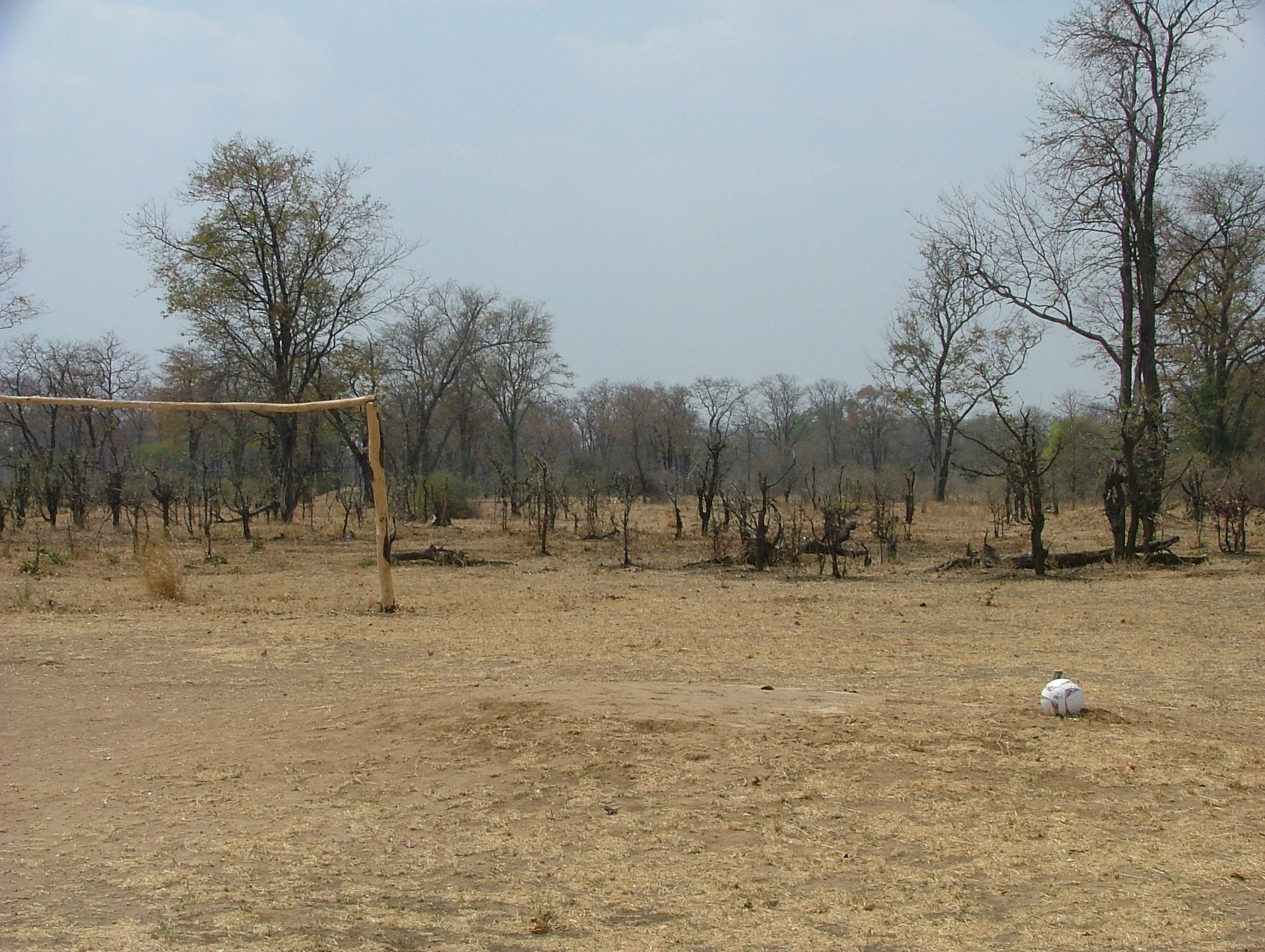
Leaving soccer balls on empty fields

Leaving soccer balls on empty fields

Villages were rural and apparently saw many more aid workers than tourists. Some villages had soccer fields where we left new soccer balls and drove away (we saw local kids playing with soccer sized wads of plastic wrapped with strips of inner tube).

Our advice: ask several locals about the road, arrive at the Petauke road-head early in the morning, dry season only, don’t go barreling across any concrete bridges, have GPS and a satellite phone, and be OK with spending the night if night falls or you break down. Be comfortable with being stranded in the bush of Africa. Or, take the Chipata Road where there will be traffic.

No Bridges? No Problem!

P1000208From our Tracks4Africa map, we knew that there was one bridge out before reaching the Mfuwe area, but there was a work-around. However, we didn’t expect many bridges to be out. Nearly all the crossings were dry, and most of the bridges were simply a concrete slab. Several of those slabs had collapsed or washed away – some were marked with the national hazard marking: a stack of branches and brush. But, some were not. Each time we got to the lip of a crossing, we stopped to peer over the hood of the rover to see if it was go or no. The numerous tracks generally showed the way around.

We suspected that we were getting closer to the Mfuwe area when the track turned into a recently graded road. We came to an open valley: zebra, giraffe, impala, baboons, warthogs, crested cranes and more. Enchanted, we stopped. Steve decided to take an early sundowner – after all, he had been driving rough tracks for hours. I was a little anxious to keep moving, as we still had about 40 kilometers to go. We pulled down to the edge of the valley, and Steve pulled out the side awning, unfolded the chairs and popped a beer. After Steve took a short nap (I still can’t figure out how he can sleep in these chairs), we folded everything back up and got back on the road.