Archives

Urban Respite

After the hustle and congestion through Lusaka, landing at Pioneer Camp was a refreshing oasis. Although “pioneer” conjures images of rustic accommodations, the site was more like an urban park. An open air A-frame served as front desk, bar and common area, with the restaurant just outside. A rugby game muttered from the television, and several European languages could be detected from the clumps of guests. An expansive lawn area, shaded by trees, served as the camping area. A pool served as the first swim-able waters we’ve seen since Chanters in Livingstone.We meet Ann and Geoff from England, although Ann is actually an American expat from Ohio. We trade travel stories, and then retreat to our tent to cook dinner. While the background noise is more urban, this is one meal I can fix without looking over my shoulder for anyone hungry, besides my husband.

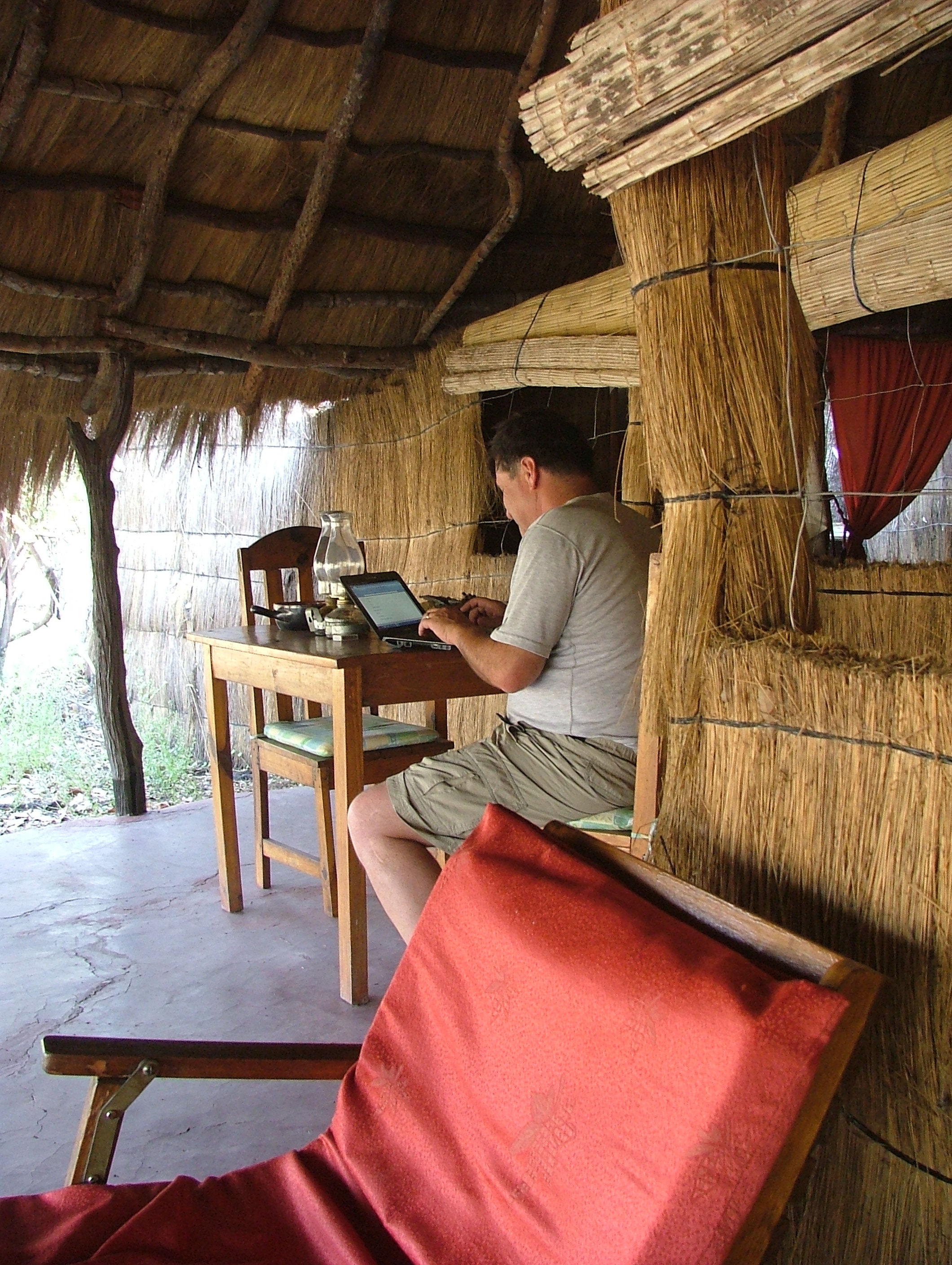
After dinner we indulge in a glass of wine at the bar and we send reassuring email to family and friends using the netbook we brought along and the available wi-fi. On future trips we will probably leave this piece of technology behind and family will just have to wonder whether we will return.

Health and Hubcaps

The US State Department runs a very comprehensive website devoted to international travel information for each country in the world. The site is full of useful information, and dire warnings. We approach Lusaka with a healthy dose of concern, especially since the US Embassy has issued several warnings about carjackings in Livingstone and Lusaka in recent months. We have to navigate from one side of the city to another, with maps with conflicting information. The route is laced with several roundabouts, adding to the challenge of driving on the left in city traffic.

Vehicle, bicycle and pedestrian traffic all increase as we approach the city. The west side is the industrial side of town, as we started to get hemmed in with high walls surrounding large buildings and mountains of scrap. Building materials are piled along the road, and in places women are working, breaking larger rocks into smaller gravel by hand.

The congestion increases as we approach the city limits, as vendor stalls stand cheek to jowl outside the factory walls. They leave only a small pathway bordering the paved road, full of pedestrians, bicycles and carts. Many stalls sell clothing, cell phone minutes, shoes, tools, plastic baskets and buckets. One stall advertises “Traditional Medicine and Hubcaps.” One man goes by with a wheelbarrow full of cattle heads. Vendors on foot walk between the stopped vehicles hawking shirts, hats, or anything else they can carry. We did as advised by the State Department and Safari Drive: we kept our windows rolled up and doors locked.

My job was to keep us headed east, helping Steve exit each roundabout at the right spot. We watched for the big shopping centers, since Lusaka was our re-supply stop, but we missed them while trying to keep track of traffic and pedestrians. Soon we were at the Lusaka airport, so we knew we were not far from our stop: Pioneer Camp. We kept going, knowing that we had a short drive the next day. We would have plenty of time to backtrack to Lusaka for fuel and groceries in the morning.

Going East

Over the past three mornings, we enjoyed many of the trees in bloom: some subtle, some showy, in color, size and scent. But, no lionesses this morning. Our last morning at McBrides’ we took a relatively short walk to track the three lionesses, but it was largely a botanical walk – no carnivores in sight. We settled our bill and pointed our land rover east, headed out of the Kafue for the cross-country drive to South Luangwa National Park.

Since we had not been driving for the past few days, our plan was to blow past the black marketers in Mumbwa and fuel up in Lusaka. Our next stop was Pioneer Camp, just east of Lusaka.

The drive out did not seem to take as much time as the drive in, and we were soon on the pavement of the Great East Road.

McBrides’ – Steve’s 2-cents

Visiting McBrides’ was our idea and was not recommended by Safari Drive. They were probably right.

While at Kaingu, we had met two young women finishing out their thesis on the distribution and habits of puku. These young adventurers had abandoned McBrides’ after finding the camping just too dirty and primitive. Anxious to get out of Rover and go walking, I unilaterally (read: stupid guy mistake) decided to bargain for a ‘chalet.’ My logic was that instead of paying the camping fee and then the ala carte pricing for walks and boat rides, we’d pay a little more and have a bed, bath, and flush toilet.

McBrides’ is poorly maintained or perhaps deliberately primitive. Although famous for his lion research, Chris is colonial English all the way. He is nice, but odd.

Wildlife is first, guests are second. One morning Carolyn shoo’ed away a bird that had flown into the dining area and was snacking at the buffet. Carolyn was scolded by Chris for offending one of his favorite birds. And at every meal it’s important to get a plate before the ants swarm the buffet table.

On the upside, the game at McBride’s is totally relaxed and comfortable. Chris lives WITH the game. As Chris said about lions hunting through camp: “Isn’t it lovely?”

Bush Trade – Take 2

As we returned to the camp from our evening lion viewing, we passed the staff housing area, which included a place for John, a member of the ZAWA anti-poaching patrol, who lives at McBrides’ camp. Patson, a member of the camp staff, had been out on anti-poaching patrol that day with John. They had apparently found a well-used, but unoccupied, poacher camp, and brought back bones and animal parts that had been left behind. They said that they had burned all the blankets and other equipment that had been left behind by the poachers.

Poaching had been very much on our minds as we planned this trip. From our research, we knew that Kafue National Park was vast, and that ZAWA was significantly understaffed and underfunded. In our travels, we heard varying opinions about ZAWA, and my guess is that the variety was due to the variety of ZAWA personnel from location to location. The personnel seem to be spread thin over the massive national parks, thus are probably minimally supervised. In some places, the attitude was that ZAWA was corrupt and in cahoots with the poachers. In other places, ZAWA was heralded as the savior of the national parks. I tend to believe both are true.

Zambia is replicating what other countries have found successful: creating GMA’s (game management areas) surrounding national parks. They provide buffer areas around the parks that allow for limited hunting, which is a lucrative business for many African countries. But, without the personnel to manage the access into the parks, and with minimal infrastructure to facilitate patrols, most management occurs within the radius of the camps.

We were told that the poachers use bicycles to get into areas, and to move their “catch” to market. Often, ZAWA are also only provided bicycles for patrol, and are often outgunned and outnumbered by the poachers. Interestingly enough, the poachers are not only after ivory, but also animal parts that are powerful for traditional medicine. This can include vulture heads and parts of rarer animals, like pangolin.

And all of those bush fires? Some blame them on the poachers, either to drive animals, or to sprout new grass to attract the grazers. Others blame ZAWA, saying that the bicycle patrols do not want to ride through the tall grass, so will set fires to increase visibility and reduce the chance of attack by lions. Yet others say that it is just the cycle of life in southern Africa, as most of the plants are fire adapted, and not really damaged by the smoldering ground fires. However, the fires must have human origins, since there were few clouds and no weather events to strike sparks while we were there. But, given the long human history on the African continent, human actions over the millennia may have selected for fire-resistant species.

Cats on our Doorstep

This morning, we took a boat across the river to walk in a part of the park devoid of tracks and vehicles. Despite the lack of human activity, we only saw herds of puku and one snoozing hippo, who got a very wide berth. Again, we walked through tall grass, palms and anthills – all unnerving with the reputation for lions in this area.

Returning to camp for brunch, we spotted four elephants headed into the water downstream from us. Chris and the staff retreat for siesta, so they left us alone to watch. One elephant wanted to cross, and worked at enticing the other three into the water. After much cavorting, splashing and bubbling in the shallows, the elephants organized themselves in a line and crossed the river.

We retreated to the deeper shade of our hut, showered and washed clothes. In Steve’s case, he just stepped into the shower clothes and all. The day was hot enough that everything would be dry before tea time. We flopped on the bed for a nap, when Chris suddenly arrived, quite excited, saying that the staff had spotted lions near the camp. We scrambled for shoes and cameras, quickly trotting out to Chris’s land rover. Both Steven and Gift were there, clearly dressed for comfort, not for serving guests, very excited.

This slideshow requires JavaScript.

Just up the riverbank from the camp, near the campground (where we originally planned to stay), we spotted one, two and then three lionesses, all with fresh blood on their faces. A very alert herd of puku gave away their position. In the heat of the day, it was clear that the lions were trying to stay in the limited shade. The largest of the lionesses moved closer to the river, flopping down under a tree in full view of the land rover. We were able to eventually move the land rover into a position to see that one of the puku had become lion lunch.

We returned to camp: it was really hot in the sun. As we walked back into camp from the land rover, it was quite apparent that the hunting lions had actually walked through the camp: there were lion prints all over the paths between the huts and the common area! It was probably only a matter of minutes that Steve and I had missed the lions when we walked back to our hut, after watching the elephants crossing the river. Yikes!!

After tea, we loaded back up in Chris’s land rover to visit the lions. The offal was all that was left in the place where we had first spotted the kill. Each lioness had found a new spot: two were still working on pieces of the kill, while one lounged on her back, belly full, clearly undisturbed by our approach. We watched until it was almost too dark to see.

Kafue on Foot

By the next morning, it was clear that things had been tidied up when we went for our pre-walk coffee. The dirt between the kitchen and dining areas had been raked, and when we returned from our walk, someone had made our beds, supplied us with towels and swept out our hut.

The food was quite simple – the chef was on holiday – but a nice change from the more formal fare we had at the previous camps. Again, it felt like we were visiting someone’s home.

The animals are decidedly more relaxed near this camp, though. Puku graze not 20 yards from the “porch” of our chalet, and birds perch closely wherever we go. I am constantly entertained by the grunts, snorts and chortles from the nearby hippo pods, and there is regular elephant “traffic” in the camp, evidenced by the numerous dung piles and broken trees.

Our first morning walk was beautiful, although punctuated with uneasy moments. Dapper in a jacket and muffler, Chris had a camera slung over one shoulder and his rifle over the other. Steven, one of the young staff, accompanied us with water, snacks and the radio. We saw mostly relaxed animals: impala, puku, waterbuck and warthogs.

Chris is known for his lion research, done 40 years ago in Botswana. There are supposedly lions regularly near this camp, but we know that it’s a matter of being at the right place at the right time. We saw spoor, but no lions. That doesn’t mean that the lions did not see us. But, the relaxed game suggested that no lions were hunting in the area.

We crossed a dry river channel both on the way out and back from the camp – these moments creating the most anxiety. Partially, this came from reading our escorts’ demeanors. In Botswana, the time we had witnessed lions make a kill had been along a similar alleyway of bush. The riverbed seemed like a perfect place for an ambush, and it was clear that Steven had similar thoughts in mind. But, after 3 hours of walking, no lions. We’ve been told that lions can stroll through the camp with “stupefying nonchalance.” But, none yet.

We had a lovely afternoon cruise down the Kafue River on a double-decker pontoon. The upper deck gave us a view above the high banks of the river, and a kingfisher’s view of the water.

Kafue North – McBrides’ Camp

From Mumbwa, we left the human settlements behind more quickly than Kalomo. There were fewer walkers and bicycles but more vehicles. It’s clear that there is something small-scale industrial happening before the national park gate.

Once past the gate and into the park, we saw no game for many kilometers, although the flies were with us, telling us that there had to be some game present. We followed a combination of written instructions, GPS and signs with arrows to navigate to McBrides’ Camp. There was a lot of nothing for a long time – we could have wandered for hours without all the aids.

We were greeted by one of the camp staff, and soon afterward the legendary Chris McBride appeared – tall and lanky with close-cropped gray hair and beard with a rifle slung over one shoulder.

Steve did the math – this leg of the trip was not pre-paid, so he negotiated for a chalet rather than the camping reservation we had pre-arranged. I’m still mystified why he did this; I was actually looking forward to being independent again, defining how we spent our time. It was clear that they had not planned on non-camping guests – it was a bit of a scramble to get us a meal and a chalet. Things were closed up: it seemed like they were not expecting guests for several days.

DSCF3659Compared to the other chalets, this place was a little rough around the edges. Where there are floors, they are poured concrete, cracked and unevenly finished. The furniture matches from seating area to seating area, but the overall feel is like you have stepped into someone’s home. Books are randomly stacked, skulls, feathers and other artifacts are tucked into the reed walls, with framed prints and botanical collages.

Unfortunately, Chris’s wife Charlotte is away in Lusaka for a few days. My sense is that she is the one that keeps the place running. Chris is a witty conversationalist, and he is clearly seen a lot of life. He holds what we consider traditional South African views. A bush dweller most of his life, he reflexively brushes flies from his face and neck every minute or two, even though the place is mercifully fly-free – probably because we are right on the Kafue River.

Our chalet is basically a boma with a concrete floor, furnished like a studio apartment. We have a spacious bathroom with an open roof and just enough privacy. It feels like we have moved into someone’s house who wasn’t really expecting guests: it’s bit dusty and the bush seems to be slowly taking over the structure. I am convinced that if I get infested with something, it will be here.

Tsetse Flies – Steve’s 2-cents

It’s sooooo easy for my dearest wife Carolyn to barely mention the tsetse flies. Easy when you have a piece of bait along to attract the flies away from you, my dearest Carolyn!!!

I’m not an Africa expert, but apparently, with the wilds of African wildlife come the flies. But the two parts are important: wilds AND African wildlife. Less wild areas have tsetse fly control, so you can go to less wild areas and not put up with the flies. If there is wildlife and true wilderness, there will likely be tsetse flies. But apparently the flies around wildlife seldom carry sleeping sickness. It’s the flies around cattle that carry the sickness.

Sickness or not, the tsetse flies were a big problem that impacted the pleasure of my trip. If I stepped out of Rover mid-day I was swarmed with literally a hundred big biting flies. My legs were covered with scabs. The itch was really incredible, especially in the middle of the night. Little worked to dissuade the flies other than to travel with the windows rolled up, air conditioner on, and avoid being out of the car other than morning and nights. Long pants and long sleeves helped, but I’m a shorts and flip-flops kinda guy.

Thirty percent DEET did nothing. I think 100-percent DEET did work but as some will know, 100-percent DEET is disgusting and literally melts paint, plastic, and some clothing.

We heard rumor that the Australians had a product that worked. If anyone knows of it, please post or email.

In retrospect: Tsetse flies were never in towns or rural areas. Flies were the worst, by far, in Kafue. Less near rivers. Flies were bad in the woods, less in the open (bad everywhere, except near rivers, in Kafue). They are attracted to black and blue and movement. When we drove along, scores of flies would be attracted to Rover and they would lay in ambush for us to step out.

So the dilemma is: Do you want the WILDS of AFRICAN WILDLIFE, complete with tsetse flies, or do you want the more civilized areas?

If it is any guide to how much the flies will bother you, mosquitoes are also attracted to me, and not to my dear wife Carolyn, who brings me along as BAIT to keep the bugs off her!