Archives

High Country

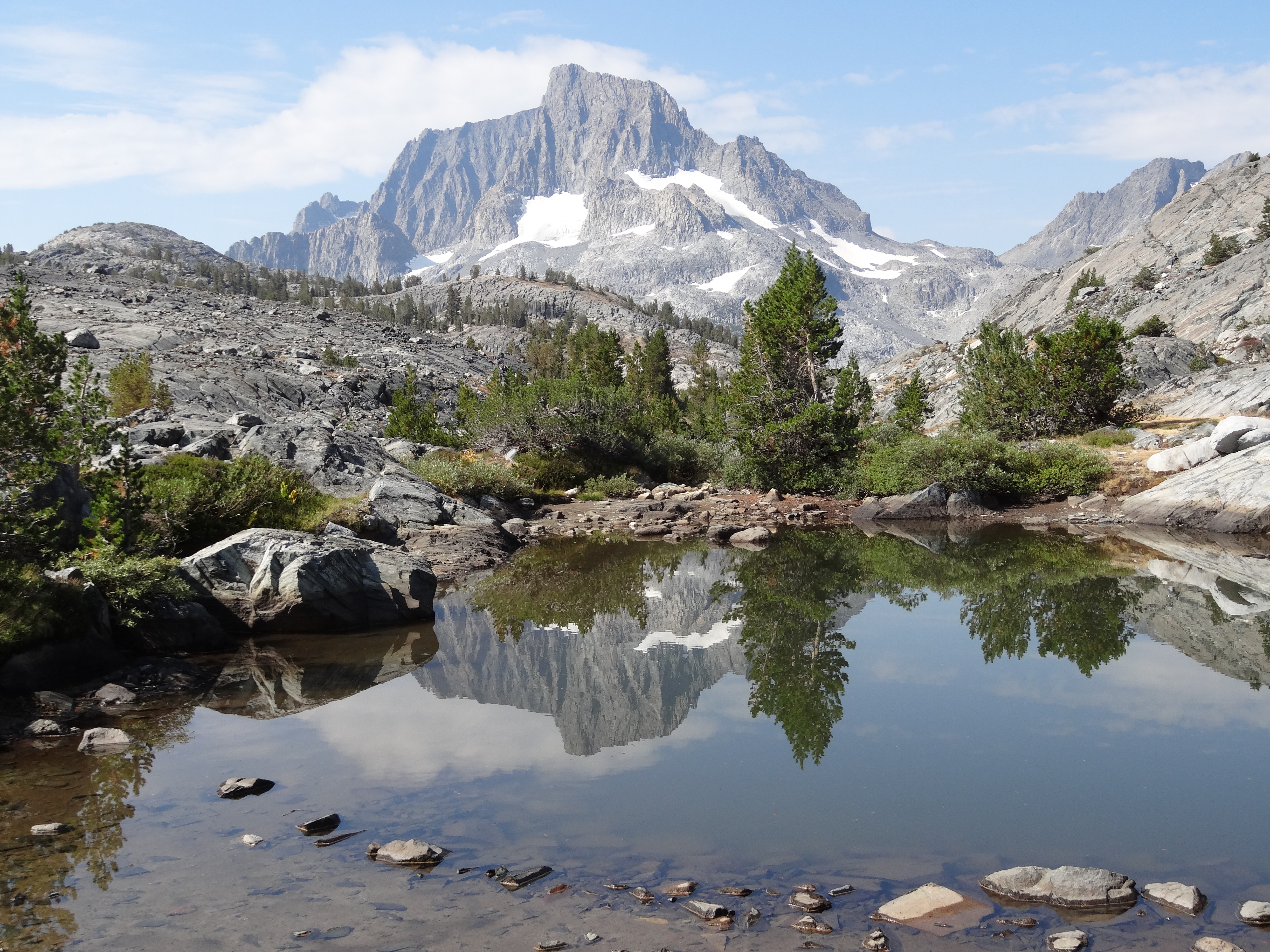
I knew that once we reached the summit and the lake that we would have a great view of Banner Peak. Coming around the last turn, the view was breathtaking in the morning light, reflecting on the lake. The grandeur of the landscape is always humbling, making me grateful to be able to spend bits of my life in such beautiful places.

Reaching Thousand Island Lake, we are now hovering around 10,000 feet in elevation. While walking on the level is not a problem, any uphill exertion comes with heavy breathing. We adjust our pace accordingly.

There are areas on the eastern end of the lake closed to camping. Once we get past the closure, we see a number of camps, including a sizable group, packed in and dropped off for the week by a pack team. We stop to chat with three young women at the camp. They excitedly tell us about the bear who waited patiently for them to go to sleep, resting his chin on his forepaws, and unconcerned by the commotion and flashlights. During the night, he had raided one of their food containers. Apparently, bears like lettuce, but not tomatoes.

We had heard about bears from other campers in the area, and it confirmed our wisdom to stay away from the crowds, where the bears know that the pickings are plentiful.


Up and Over

We fairly easily scaled the low pass over to the top of the Garnet Lake area, once we adjusted our pace to the rate that our lungs could mop up oxygen from the thinner air.

The Sierra snow pack had not been plentiful so the marshy places and creeks were easily crossed. We came to a lovely spot on a bench between two small lakes above Garnet Lake, pretty much in time to set up the rain fly to hunker down against the weather.

It’s going to be another long soggy afternoon and evening.

River Trail

Many trails junction at Agnew Meadows, including both the Pacific Crest Trail (PCT) and John Muir Trail (JMT).  There is also a pack station there, so there are hikers, backpackers, cars, horses and mules.  The campground is closed for clean-up from a windstorm earlier in the year, otherwise there would be even more “traffic.”

Our route was based on a trip posted by a Tahoe area photographer: http://tahoelight.com/blog/2009/08/minaret-lake-thousand-island-lake-backpacking-loop-and-landscape-photography/  While their trip took four nights, we stretched ours out into five nights.  We knew that weather and adjustments to altitude could affect the trip, and we didn’t want to be “in hurry,” as that’s how many accidents happen.

We found our way to the lower “river trail,” which follows the San Joaquin River to its source: Thousand Island Lake. This is a maintained trail, so we are grateful to not have to skirt or climb over all of the fallen trees from an earlier wind storm.  We encounter plenty of hikers coming down the trail, and several on their way in.

But, we are keeping our eyes on the weather as we climb towards the pass.  The clouds are gathering and the temperature is dropping.  If we are going to get rain like yesterday, we need to find a stopping place that could also function as an overnight camp.  We know we are less than two miles from the lake, but it doesn’t appear that we would be near water until up on top.

We stop at a spot near the trail and near the river.  It’s clearly a camp: there are several “hearths” and there are even two large tin cans with wire handles at one of the hearths.  Steve rigs the fly, and we pull out our sleeping bags to wait out the rain.

We wait. We nap.  We wait some more.  Near nightfall, we decide that we need to eat, even though we really aren’t hungry.  Looks like we are here for the night, and not at the lake.

We’re still in the pines, so we know that there is a good chance for bears, especially because we are at an established camp.  We put the two bear-resistant canisters of food far from us, and in a location where they won’t roll down into the river if discovered by bears.  Steve puts rocks into the two tin cans and places them at the head and the foot of the fly.  The rattle should wake us up and startle any nocturnal visitors.  We brought a can of “bear spray” but it would better if we don’t have to use it.

It continued to rain into the night.  Steve had to become his own engineer as the water started to pool on the ground near his head.  Sometime in the night, I woke up to see stars.  Maybe tomorrow will be a less rainy day.

Park Here, Shuttle Where?

In our research we found varying information about the shuttle into Red’s Meadow/Devils Postpile area, where we would be entering and exiting the wilderness area.  Word is that the road is closed to general traffic from 7 am to 7 pm, and this we found was generally true.

Our experience with the shuttle was another matter.  According to the information we found, reconfirmed by the ranger when we picked up our permit, was that the shuttle starts running at 7 am, and runs continuously every 15-20 minutes.  We didn’t feel that we needed to get the very first shuttle, but we were mindful of the potential for rain, and the distance and elevation gain of our first day, with our packs at their heaviest, and us at our least adjusted to altitude.

We changed into hiking clothes and boots, parked the car and headed towards the lodge building.  The shuttle stop location was not immediately obvious from the parking lot, and we wandered around until we found what looked like the spot.  The ticket window opens at 8 am, so we purchased our tickets ($7/person for a round trip ride), and went to stand at the stop, the first in the queue.  There was a bean bag toss game out on the lawn: we challenged each other to a bean bag duel.  This would amuse, and we could easily see the shuttle coming.

8:15 came and went. No shuttle. Then 8:30. Then 8:45.  At about 8:55, a shuttle finally pulled up.  By then, there was quite a line, including numerous backpackers who were probably just as anxious as us to get on the trail.  Once on the shuttle, the driver half-heartedly apologized for our wait, that a driver had not shown up for work.  So, it appears that balls were dropped to not fill in the missing driver.  And no one associated with the shuttle service seemed to care much.

The road is narrow, steep and winding – with a breathtaking view.

When we got off the shuttle at Agnew Meadows (the first stop), we found that there were plenty of parking spaces there (contrary to the information from the ranger).  Next time, we will get up early enough to drive ourselves in, and use the shuttle to get back to our car.

Morning Departure

We were up at dawn. We rolled up our bulky, but comfy, cotton sleeping bags and stuffed them in the trunk. They take up more space than our two backpacks, which are now in the back seat of the car. As we drive out of the campground, we see that someone had not latched the garbage bin, and the host was cleaning up the mess made by resident bear(s). Back in town, we stop for a hot breakfast, and then head to Mammoth Mountain Lodge to pick up our shuttle to Agnew Meadows.